Fake World
When People Don't Know What They Had Done
Showing posts with label campaign. Show all posts

Those scoring the undercard match between the U.S. and China at the U.N. conference on climate change in Bali would have given it to China on points.
Beijing scored for being seen to be a constructive participant whereas Washington was seen as obstructive. China’s media has been playing up U.N. Secretary-General Ban Ki-moon’s comments about how China has sent a positive signal to the world over climate change. As such Beijing emerged as a leading spokesman for developing countries, especially the fast emerging economies such as itself, Brazil, India and South Korea.

Beijing also saw off U.S. attempts, mainly for domestic consumption it should be noted, to portray the view that climate change is now really China’s fault, and thus China should be pressed into accepting binding numerical targets. The Bush administration, despite its volte face on climate change earlier this year, has no great appetite for binding targets for itself, but it certainly doesn’t want to have them imposed on it but not on China. Plus, the technology, voluntary targets and energy efficiency approach it is pushing promises future business for American companies that sell green and clean technologies, so it wants China and other developing nations to have a reason — and a deadline — to buy them.

This is all geopolitical power jockeying and doesn’t change any of the underlying facts: Per capita emissions in the U.S. in 2004 were about five times higher than China and 16 times higher than India’s. However, China may by now have overtaken the U.S. as the world’s largest total emitter because of its population size, rapid growth and reliance on coal to generate electricity.
And Beijing, too, has a domestic political agenda to be seen as green that goes beyond the environmental need to make the air breathable and the water drinkable. The leadership doesn’t want to cede a power vacuum around the issue into which a future possible rival could step.

source : unfcccbali.org
 

UNCCC 2007 : Bali Result

Posted In: . By noto

It was one day late but countries achieved a major breakthrough on international climate change action at 2:31pm Bali time on Saturday. It was not without high drama featuring plenty of twists and turns along the way on a day when many delegates had planned to catch flights home.

It even took the special intervention of Indonesian President Susilo Bambang Yudhoyono and UN Secretary-General Ban Ki-moon to exhort delegates to complete what seemed like hopelessly deadlocked talks.

Yudhoyono called on countries to complete "the most difficult mile," of an "exhaustive marathon." He told delegates that we could not allow "the human race and the planet to crumble because we cannot find the right words."

The Secretary-General, who returned to Bali after a visit to Timor-Leste, said he was reluctant to speak again to the conference but that he was disappointed in the progress that had been made. "The hour is late. It is time to make a decision." He appealed to delegates not to "risk everything you have achieved so far."

After a morning of false starts and false hopes, miscommunications and misunderstandings, countries agreed on a roadmap to launch negotiations toward a global, comprehensive agreement to address climate change. The Bali decision sets out an agenda that frames the discussions that will take place over the next two years and sets a deadline of 2009 to complete the negotiations.

After agreement was reached, the Secretary-General issued a statement strongly welcoming the outcome and saying that the Bali Roadmap achieved all three of the main objectives. "The Bali Roadmap that has been agreed is a pivotal first step toward an agreement that can address the threat of climate change, the defining challenge of our time."

But the agreement did not come painlessly. On a key provision, concerning the obligations of developing countries in the future negotiations, India, speaking for developing countries, said that alternate wording had been agreed to during the night. And then Bangladesh said that language concerning the least developed countries and small island states had been omitted. The Philippines said the phrase "on the basis of equity" had been omitted. And then the United States said it could not accept the formulation that was put forward but offered to keep working until an agreement could be found.

Then South Africa, responding to the US, said developing countries had voluntarily moved to accept new obligations for their national actions on climate change that were "measurable, reportable and verifiable," a concession that only a year ago, he said, "would have been unthinkable." South Africa asked the US to reconsider its position.

Then an avalanche of countries took the floor in support of the developing country position, many asking the US to state their reservations separately and not block a consensus.

US Under Secretary of State Paula Dobriansky took the floor again and said the US wanted a roadmap and wanted to be part of the roadmap.

"We are very committed to long-term greenhouse gas emission reductions," and she said the US would work with other large emitters to halve global emissions by 2050. And then she said the US "will go forward and join the consensus," which was followed by a thunderous ovation.

"It feels like we are in a movie with lots of plots," said the delegate from Egypt.

After full adoption by the plenary, countries thanked the US for joining the consensus and thanked the secretariat of the Climate Change Convention and the Indonesian government for hosting the Conference.

Source: United Nations Climate Change Official Site


On Feb. 2, 2007, the United Nations scientific panel studying climate change declared that the evidence of a warming trend is "unequivocal," and that human activity has "very likely" been the driving force in that change over the last 50 years. The last report by the group, the Intergovernmental Panel on Climate Change, in 2001, had found that humanity had "likely" played a role. (The NY Times)

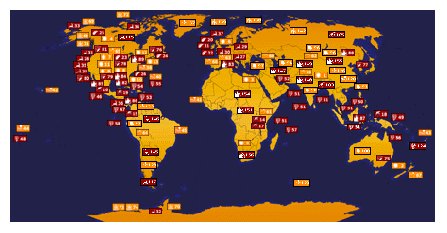
sumber : climatehotmap.org
This map illustrates the local consequences of global warming.
Download versi PPT file on : http://www.climatehotmap.org/powerpoint/mapslide.ppt

Global Warming atau istilah kerennya pemanasan global saat ini benar-benar terjadi seperti yang diberitakan NYT. Tapi masih banyak aja orang yang gak peduli atau memang nggak tahu sama sekali. Diantaranya beberapa pernyataan berikut :

1. Hal ini gak mungkin terjadi (Ilmuwan menyatakan kalo suhu bumi meningkat drastis)
2. Biasa-biasa saja, alami (Suhu meningkat, khususnya sejak tahun 1970, jauh dari variasi alami yang terjadi)
3. Efeknya bertahap (Badai di beberapa negara menjadi semakin hebat, tapi sejarah iklim menunjukkan bahwa iklim berubah tajam terjadi dalam waktu singkat beberapa tahun terakhir)
4. Cukup baik bagi sebagian negara (Beberapa negara mungkin akan diuntungkan (seperti kata Pak Mentri Anton A) tetapi efek negatifnya jauh lebih besar dibandingkan keuntungannya, penyakit dan kematian akan meningkat)
5. Pertanian akan diuntungkan (Karbondioksida mungkin membuat beberapa tumbuhan tumbuh dengan cepat, namun juga rumput liar, hama, dan kemarau. Pertanian tidak akan tumbuh baik.
6. Biar ditangani pemerintah aja (Kita semua harus berpartisipasi, jangan hanya berdiam diri)
7. Teknologi akan memecahkan masalah ini (Teknologi rumah kaca gitu, perubahan sekecil apapun dapat membuat perbedaan)
8. Tidak ada yang dapat dilakukan (Setiap orang dapat membuat perubahan)

Makanya ayo stop pemanasan global !


Sponsored Ads